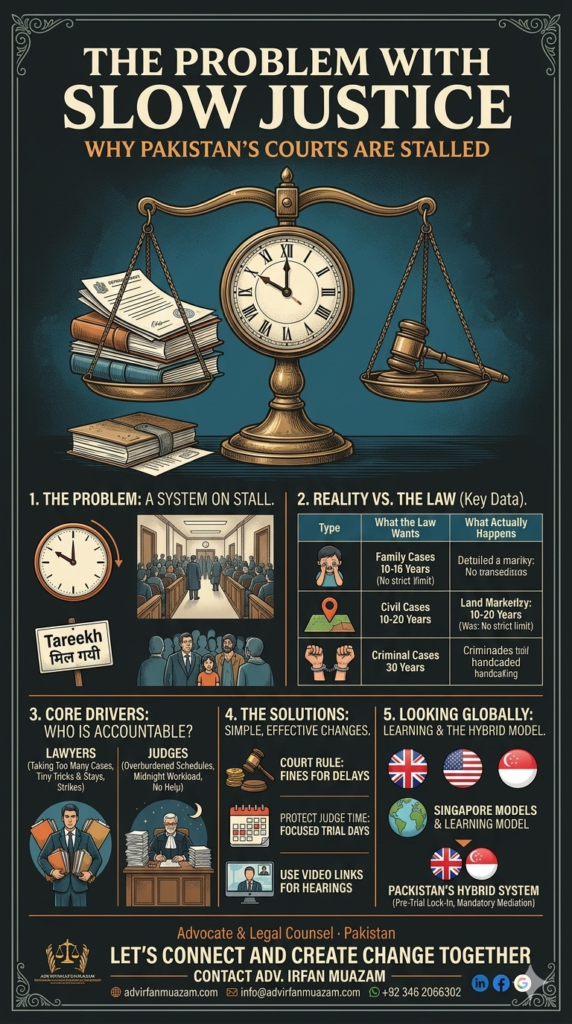
Walking into a Pakistani court today feels like stepping into a machine where time stands still. The system moves very slowly, and it can feel like it does not care about the human lives waiting for an answer. Behind the massive backlog of over 2.4 million pending cases are real families, real people, and real heartbreaks.
To understand why our courts have stopped moving, we need to look past the difficult legal words. We must examine the choices made by lawyers, the heavy workloads of judges, and the everyday struggles of ordinary people.
1. The Written Law vs. Real Life
Our law books have clear rules and timelines for finishing cases quickly. However, what is written in the law is very different from what happens in real courtrooms:
| Type of Case | What the Law Wants | What Actually Happens | The Human Cost and Problems |
|---|---|---|---|
| Family Cases (Divorce, Child Custody) | 6 Months under the Family Courts Act. | 1 to 3 Years (The rule is almost always broken). | Long delays in getting child support. Families are left emotionally and financially broken. |
| Civil Cases (Land and Property Disputes) | No strict time limit for trials. | 10 to 20 Years (Cases last longer than the people who started them). | Paperwork is done by hand. Powerful land-grabbers use “stay orders” to lock up cases for decades. |
| Criminal Cases (Theft, Assault, Crimes) | Police must investigate in 14 days. No fixed trial limit. | 3 to 10 Years (Creates massive delays). | Criminals walk free on bail for years because witnesses are scared or absent. Criminals lose their fear of punishment. |
| Tax Matters (Business Revenue) | Should be a priority; ideally 6 to 12 months. | 2 to 5 Years (Stalls state funds). | Big companies stall their tax bills for years using quick court orders. |
For an ordinary person—especially those traveling from far away in areas like the Malakand Division—going to court feels like a punishment for being poor. People spend their life savings on vans, buses, hotels, and lawyer fees just to stand in crowded hallways. Hearing the court official say “Tareekh mil gayi” (a new date has been given) in just five seconds is completely heartbreaking.
When people see that the government cannot resolve their fights quickly, they stop trusting the law. This drives citizens to use street violence, personal revenge, or illegal tribal Jirgas simply because they want an answer today, not in twenty years.
2. The Real Reasons for the Delays
The slow speed of justice is kept alive by two main groups inside the courtroom: the strategies used by lawyers and the extreme workloads of judges.
The Role of Lawyers in Stalling Cases
In our system, judges act as quiet referees while private lawyers control the speed of the case. This leads to several bad habits:
- Taking Too Many Cases: Lawyers often take on more clients than they can handle. A lawyer might have hearings in three different courts at the exact same time. To fix this, they send a junior assistant to ask the judge for a new date because the main lawyer is “busy elsewhere.”
- Using Tiny Tricks and Stays: Many lawyers are praised for finding tiny technical errors instead of talking about the actual case. They file minor applications mid-trial just to pause the case. Once they get a temporary stay order, they try to delay the final decision forever.
- Bar Association Strikes: Local lawyer groups frequently go on strike over political or professional fights. On strike days, courts shut down completely, and poor litigants see their long-awaited hearings pushed back by months.
Why Judges Cannot Write Decisions Fast Enough
It is easy to blame judges for sitting on cases, but lower-court judges in Pakistan are completely exhausted and overworked:
- Crushing Morning Schedules: Pakistan has far too few judges for its population. A single judge often has 70 to 100 cases listed on their schedule every single day. They spend their entire morning managing chaos, leaving no quiet time to sit and think.
- The Midnight Workload: Because their days are swallowed by court hearings, judges are forced to take heavy paper files home. They spend their nights dictating decisions to a single, tired court typist.
- No Research Help: Unlike judges in rich countries, our local judges work completely alone. They do not have law clerks or research assistants to read files or summarize case histories for them.
3. Looking Globally: What Can We Learn?
To fix this problem, Pakistan needs to look at how other countries run their courts:
- The Adversarial System (e.g., UK, USA): This is Pakistan’s current system. It protects personal freedom, but it gives private lawyers too much power to delay cases for money or strategy.
- The Inquisitorial System (e.g., France, Germany): In this system, the judge acts as an active investigator. The judge controls the evidence and stops lawyers from delaying the case. However, this system costs a massive amount of government money to run.
- The Smart Digital Model (e.g., Singapore): This is the best modern system. It uses strict deadlines, computer systems to track cases, and mandatory mediation to solve minor fights early.
What System Should Pakistan Adopt?
Pakistan needs to move toward a Hybrid Case Management System like the ones used in Singapore and the United Kingdom. This requires two simple changes:
- The Pre-Trial Lock-In: The court—not the lawyers—must control the timeline. A trial date should only be set after both sides have fully submitted all their evidence and witness lists. Lawyers should not be allowed to pause a trial to look for new documents.
- Mandatory Mediation (ADR): Our courts are clogged because every small neighborhood fight or family argument ends up on a judge’s desk. Making mediation the mandatory first step would instantly solve a massive number of minor civil fights out of court.
4. Simple Solutions to Move Forward
We do not need expensive constitutional changes to fix this system. We need common-sense changes that respect people’s time:
- Fines for Wasting Time: We need court rules where any lawyer who asks for an unnecessary delay must pay a cash fine directly to the opposing party. If a lawyer wastes a poor family’s day, they should pay for that family’s bus fare and lost wages out of their own pocket.
- Protecting the Judge’s Time: Courts should spend three days a week strictly running trials, and two days a week with closed doors. This gives judges uninterrupted time to read files, do research, and write their decisions on time.
- Using Video Links: We must use digital video links for simple court steps. Letting witnesses give statements or extending bails via video calls completely removes the cost of traveling from far away regions like Malakand.
Let’s Connect and Create Change Together
True legal reform starts with clear talk and working together. Adv. Irfan Muazam is an Advocate of the High Court and the head of Irfan Muazam Law Associates. Operating across Swat and district courts Malakand at Batkhela in the Malakand Division, he brings years of courtroom experience to protect your civil rights—from business disputes to sensitive family cases.
If you are a legal professional, a student, or a citizen looking for dedicated legal help, please connect with me directly through these channels:
- 🌐 Website: advirfanmuazam.com
- ✉️ Email: info@advirfanmuazam.com
- 📞 Phone / WhatsApp: +92 346 2066302
- 🕒 Office Hours: Monday – Saturday, 09:00 – 17:00
- 💼 LinkedIn: Find me at Adv Irfan Muazam on LinkedIn to read updates on legal topics and public policy.
- 👥 Facebook: Follow my page Adv Irfan Muazam on Facebook to see updates on district court news and legal awareness campaigns.
For immediate case consultation or to find my office location, you can search for my verified profile directly on Google.