
A Computerized National Identity Card (CNIC) is the legal foundation of a citizen’s life in Pakistan. Without it, a person faces an immediate “civil death.” They are entirely locked out of banking, healthcare, employment, travel, property ownership, and voting.
For years, the National Database and Registration Authority (NADRA) used digital card blockage as an easy administrative tool. However, a landmark body of jurisprudence from provincial High Courts and the Supreme Court has drawn a strict line. NADRA does not possess the unilateral, arbitrary power to block your CNIC without following rigorous due process.
If you are a resident of Swat, Dir, Malakand, Buner, Shangla, Chitral, or Peshawar and are facing an illegal digital identity freeze, navigating the complex administrative system requires expert legal intervention. Irfan Muazam Law Associates (advirfanmuazam.com) specializes in handling complex NADRA identity disputes, family law, and high court writ petitions to restore your fundamental rights before the Peshawar High Court, Mingora Bench (Dar-ul-Qaza).
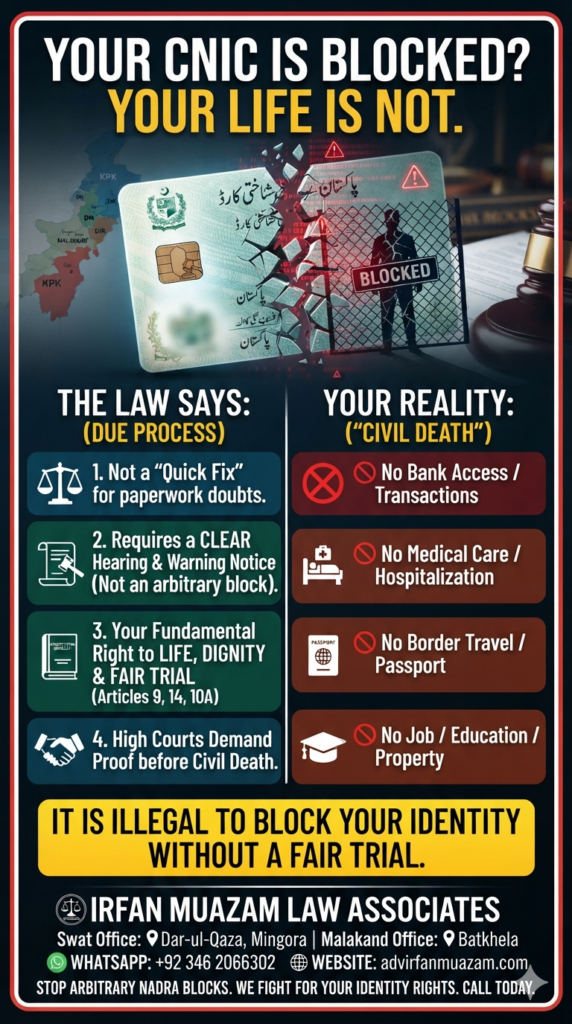
1. The Statutory Reality: “Blocking” Does Not Exist in Law
To evaluate NADRA’s executive boundaries, one must examine its parent statute: the NADRA Ordinance, 2000.
A critical reading of the text reveals a striking omission: the word “blocking” is completely absent from the law.Instead, Sections 17 and 18 of the Ordinance grant NADRA the power to cancel, impound, or confiscate a registration card under highly restricted, narrow parameters. These are legally justifiable only if the card was obtained through proven fraud, misrepresentation, or if the holder is conclusively found to be a non-citizen.
Furthermore, High Courts have clarified that Section 23 of the Ordinance only allows NADRA to gather information priorto a card’s issuance. It cannot be used to place an administrative embargo on an existing CNIC. Without a proper show-cause notice under Section 18, any administrative freeze or “digital impounding” entirely lacks legal sanction.
2. The Constitutional Barrier: Fighting “Civil Death”
The superior judiciary’s intervention is firmly anchored in the Constitution of Pakistan. When NADRA blocks a CNIC, it strips an individual of their societal existence. The courts have consistently ruled that arbitrary blocking violates core fundamental rights:
- Article 9 (Right to Life and Liberty / Security of Person): The right to life is not merely the mechanical act of breathing. It encompasses the right to livelihood, basic sustenance, and security. Freezing a CNIC directly threatens a person’s survival.
- Article 10A (Right to Fair Trial and Due Process): NADRA cannot act simultaneously as investigator, judge, and executioner. A citizen’s identity cannot be frozen without a prior written show-cause notice, an objective inquiry, and a transparent opportunity to defend their lineage.
- Article 14 (Inviolability of Dignity of Man): Reducing a legitimate citizen to an unrecognized alien without solid legal proof is an existential assault on human dignity.
                  [ UNVERIFIED ADMINISTRATIVE FLAG ]
                                  │
                                  ▼
                ❌ [ ARBITRARY DIGITAL BLOCKAGE ]
                                  │
                                  ▼
             💀 [ "CIVIL DEATH" OF THE CITIZEN ]
     (No Banking • No Healthcare • No Livelihood • No Travel)
                                  │
                                  ▼
         ⚖️ [ CONSTITUTIONAL VIOLATION OF RIGHTS ]
               (Articles 9, 10A, and 14 Violated)
3. Key Judgments & Legal Precedents (Updated 2026)
The legal battle over CNIC blocking has established powerful boundaries on executive overreach through landmark High Court and Supreme Court benchmarks:
Supreme Court of Pakistan: Agha Abid Majeed Khan v. Idrees Ahmed (2026)
In a major verdict authored by Justice Munib Akhtar, the apex court overturned an executive order that blocked a citizen’s CNIC to enforce a civil dispute settlement. Justice Akhtar remarked, “Will courts tomorrow also order the disconnection of electricity and water connections for the recovery of money?” The Supreme Court ruled that a CNIC is a basic necessity, not a luxury, and explicitly held that no court or executing agency can block a card to enforce monetary or civil decrees unless specifically stated by law.
Landmark High Court Precedents
- Peshawar High Court (2011 PLD 47): This foundational decision explicitly stressed that due process and formal hearings must take place before any blocks are enforced. In regional blocks involving the Malakand division, Swat, and Dir, the PHC heavily polices border-related scrutiny or refugee ancestry concerns, prioritizing due process over arbitrary security reports.
- Islamabad High Court (2021 PLD 105): The IHC ruled that NADRA entirely lacks jurisdiction to intervene or block identities over family disputes, inheritance issues, or paternity disputes under federal investigations.
- Lahore High Court (2024 MLD 1020): Reiterated that blocks require judicial oversight, not arbitrary executive action. Legitimate impoundments require a 15-to-30-day notice period via SMS or post, followed by a strict inquiry window.
- Sindh High Court Precedents: Mandated that NADRA cannot execute blocks without concrete, written verification and recommendation reports from relevant quarters. Similarly, the Karachi High Court (2018 MLD 1748) ordered the immediate de-blocking of an entire family’s cards due to a blatant lack of initial inquiry.
4. Common Triggers & When a Card Can Be Restricted
CNICs are frequently flagged or suspended temporarily under mechanisms like the National Re-verification Programme, where cards are marked as “suspect” based on vigilance checks, data discrepancies, or unverified intelligence reports. However, permanent or valid legal blocks can only occur under specific parameters:
Criminal Abscondance (CrPC Sections 87/88)
A card cannot be blocked just because a police investigation or an FIR is initiated against an individual. For a block to be legally valid:
- The accused must be actively evading arrest.
- The trial court must initiate formal proceedings under Sections 87 and 88 of the Criminal Procedure Code (CrPC).
- The individual must be formally declared a Proclaimed Offender (PO).
Only after this transparent judicial process is complete can the court order NADRA to block the absconder’s card as a legal tool to compel their physical surrender.
National Security and Terror Financing
Under the Anti-Terrorism Act (ATA), 1997, individuals formally placed on the Fourth Schedule by the National Counter Terrorism Authority (NACTA) face statutory administrative blocks. This specialized mechanism is designed to immediately disrupt access to financial channels and prevent terror financing.
5. Practical Steps to Unblock a Blocked CNIC
If a citizen finds their card digitally frozen, they must navigate a dual pathway of administrative and legal remedies to restore their status.
Step 1: Administrative Verification
Before escalating to the courts, a citizen should exhaust internal administrative channels:
- Verify the Block Reason: Visit a NADRA Registration Center (NRC) or call the official helpline (7000) to obtain an official status report.
- Submit Formal Response: If a notice has been served, submit an application along with supporting verification documents (e.g., birth certificates, domicile, utility bills, registered land deeds, or verified family trees) within 15–30 days.
- District Committees: Routine issues are cleared within 6 to 30 days. Complex cases flagged by intelligence go to joint district committees comprising Deputy Commissioners, police, and agency reps.
Step 2: Legal Remedies & Writ Petitions
If administrative efforts fail, NADRA denies relief, or delays exceed 3 months, immediate legal action must be taken:
- Section 23 Representation: File a formal representation to NADRA under Section 23 of the Ordinance, demanding official reasons and an audience hearing.
- Article 199 Constitutional Writ: If unresolved, file a Writ Petition in the High Court with territorial jurisdiction. For residents of Swat and Malakand division, this petition is filed directly before the Peshawar High Court, Mingora Bench (Dar-ul-Qaza).
- Seeking Interim Relief: An experienced high court advocate can petition the court for an interim stay order. Benches frequently grant immediate interim stay orders to suspend the block during hearings, allowing the citizen to maintain access to banking and basic health services while the trial proceeds.
6. The 2026 Regulatory Changes
The legal friction between administrative verification and fundamental human rights remains highly active. The National Database and Registration Authority (Amendment) Bill, 2026 passed by the Senate Standing Committee on Interior introduced a time-bound enforcement system.
Because NADRA previously faced operational constraints in freezing identities without direct court intervention, the modern framework grants NADRA explicit statutory power to “provisionally impound” a CNIC for up to 60 dayspending verification. While this aims to stop criminals from evading active legal proceedings, it places a heavy burden of proof on the state to avoid repeating past arbitrary blockades.
Conclusion & Expert Legal Assistance in Malakand & Swat
Your CNIC is a constitutional shield, not an administrative luxury that NADRA can withdraw at will. Except for strict, court-mandated criminal proceedings or verified fraud established through rigorous, transparent due process, NADRA cannot block your CNIC.
If your identity card has been wrongfully blocked or flagged in Swat, Dir, Malakand, Buner, Shangla, Chitral, or Peshawar, do not let administrative delays push you into a civil death. Professional legal recourse is available to quash illegal blocks and restore your dignity.
For dedicated legal support, swift case evaluation, and aggressive representation before the Peshawar High Court (Dar-ul-Qaza, Mingora Bench), contact Irfan Muazam Law Associates.
- 📞 WhatsApp Help Desk: +92 346 2066302
- 📧 Email Helpline: info@advirfanmuazam.com
- 🌐 Official Web Channel: advirfanmuazam.com
- 📍 Swat Office (Main Chambers): Floor No. 1, Office No. 2, Near Swat Shopping Mall, Opposite to Dar-ul-Qaza Mingora, Swat, KPK, Pakistan
- 📍 Malakand Office: Office No. 12/19, Lawyers Chambers, District Courts Malakand at Batkhela, KPK, Pakistan
- ⚖️ Practice Focus: NADRA CNIC Unblocking, Constitutional Writs (Article 199), Family Law, Child Custody, Property Litigation, and Criminal Defense in Malakand Division.