
By the Chambers of ADV IRFAN MUAZAM — Senior Counsel & Tax Law Specialist, Swat & Malakand Division
Executive Summary
The fiscal transformation of the Malakand Division from a historically tax-sheltered region into a fully integrated, documented economy represents one of the most critical regulatory shifts in Pakistan’s modern jurisprudence [The FATA/PATA Tax Shift: The…]. Following constitutional amendments and the gradual withdrawal of regional tax immunities, individuals, traders, and corporate bodies across Swat, Mingora, and the wider Malakand region face an aggressive, data-driven regulatory enforcement strategy implemented by the Federal Board of Revenue (FBR) [The FATA/PATA Tax Shift: The…].
Operating under the statutory mandates of the Income Tax Ordinance, 2001, the annual filing of an income tax return has evolved beyond a routine administrative exercise. It now functions as a primary asset defense mechanism. In an era defined by automated banking oversight and digital transaction mapping, retaining specialized counsel from an experienced tax lawyer in Malakand Division is essential to insulate personal wealth, protect commercial liquidity, and defend corporate entities against punitive state action.
I. STATUTORY ARCHITECTURE & HEADS OF INCOME
To ensure absolute compliance within the FBR’s Iris portal, all gross annual revenues must be meticulously categorized, reconciled, and declared under the five recognized statutory heads of income:
- Salary (Section 12): Encompasses all base wages, perquisites, performance bonuses, and employer-matched funds derived from employment contracts.
- Income from Property (Section 15): Governs all accrued or receivable rent from land, commercial plazas, and residential real estate assets.
- Income from Business (Section 18): Tracks net profits generated from trading, corporate retail, digital service sectors, hotel management, and manufacturing operations.
- Capital Gains (Section 37): Applies directly to the net profits realized upon the disposal or transfer of capital assets, including immovable property and movable securities.
- Income from Other Sources (Section 39): Serves as the catch-all framework tracking miscellaneous financial streams, including profit on debt (bank interest), equity dividends, and international inward remittances.
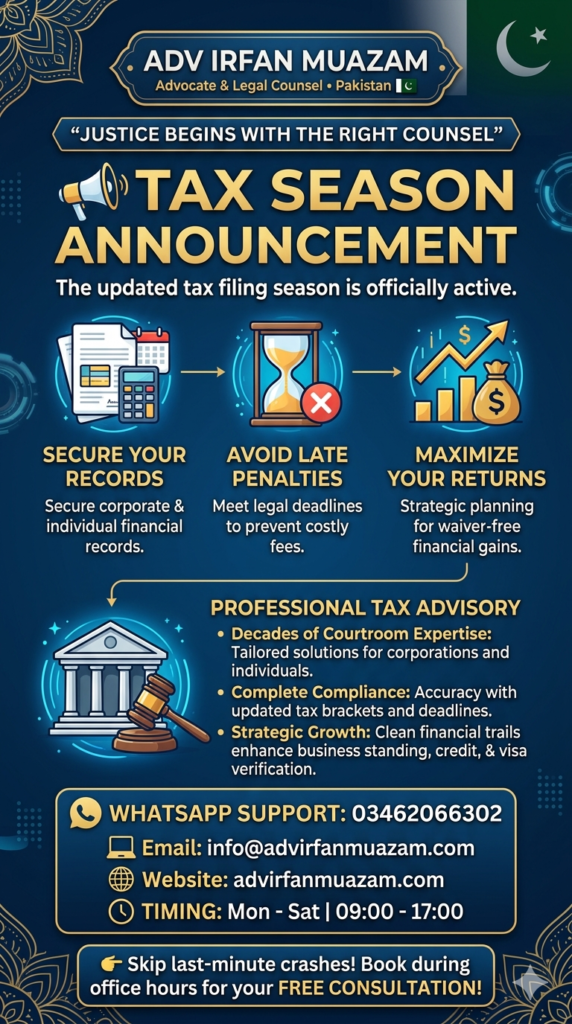
II. ASSESSMENT TRAPS: THE REGIONAL COMPLIANCE RISK
The FBR has aggressively expanded its automated data-mining capabilities. The northern corporate sectors are no longer isolated from federal oversight; local economic activities are actively matched against external datasets.
As a practicing tax lawyer in Swat, our diagnostic reviews highlight three critical statutory traps where regional asset holders face immediate liability:
- The Active Taxpayer List (ATL) Surcharge: Missing the standard statutory filing window results in immediate deactivation from the ATL. Restoring active status requires an immediate statutory penalty payment of PKR 25,000 for individuals, PKR 50,000 for Associations of Persons (AOPs), and PKR 100,000 for corporate entities.
- The Six-Month Real Estate Embargo: Under the restrictive provisions of Section 182A, late filers seeking to bypass ATL penalties face a severe penalty: an absolute statutory prohibition on buying, selling, or transferring any form of immovable property for a minimum of six months. For the expanding real estate markets of Swat, Mingora, and Kabal, this restriction can completely freeze vital business transactions.
- Automated Audit Triggers (Section 116 vs. Lifestyle): The FBR actively cross-references third-party data. Any visual mismatch between a taxpayer’s undeclared wealth and their visible lifestyle footprint—such as international travel logs, high-capacity electricity connections, or luxury vehicle registrations—triggers automated statutory audit notices under Section 122 or Section 177.
                       THE DIGITAL ENFORCEMENT LOOP

   +-------------------+      +-------------------+      +-------------------+

   | High-Value Asset  | ---> |   Automated FBR   | ---> |  Punitive WHT or  |
   | Acquisition       |      | Data Matching     |      |  Account Freezing |
   +-------------------+      +-------------------+      +-------------------+
             ^                                                     |
             |                                                     v
             +------------------ Audit Selection <-----------------+
III. PREVALENT STRUCTURAL FLAWS IN LOCAL REVENUE PROFILES
Traders and families throughout the Malakand Division frequently incur significant tax liabilities by relying on uncertified data entry clerks rather than professional legal counsel. As a specialized income tax lawyer in Swat, our chambers frequently intercept and correct three major errors:
- The Foreign Remittance Pitfall: Malakand Division holds a substantial overseas diaspora sending capital back to the region. Declaring international commercial profits, digital service earnings, or trade revenues as “simple family gifts” without securing an official Foreign Remittance Encashment Certificate (BREC) under Section 111(4) invites immediate hidden-wealth prosecution.
- Flawed Wealth Reconciliation: Failing to precisely balance annual net asset growth against actual household consumption expenditures causes a mathematical mismatch in the FBR database, resulting in the immediate suspension of active status.
- Under-Reporting Corporate Turnover: Local manufacturing units, hotel chains, and major retail traders often file zero-rated or minimized personal returns while executing substantial banking transactions. This structural mismatch is the number one cause of sudden, aggressive bank account freezing.
IV. SECURING PROFESSIONAL LEGAL DEFENSE
A clean, professionally managed tax profile does far more than just insulate a business from FBR penalties. It builds vital commercial credibility, unlocks secure lines of corporate credit with commercial banking institutions, and establishes a transparent financial history essential for securing international travel visas for business expansion.
The Chambers of ADV IRFAN MUAZAM deliver courtroom-tested tax litigation experience and corporate legal advisory services tailored specifically to the regional economic dynamics of Khyber Pakhtunkhwa. Whether you require a specialized tax lawyer in Malakand Division to defend a complex audit notice or an expert advisor to restructure your corporate filings, we ensure your wealth is robustly protected under the law.
- 📞 Direct WhatsApp Consultation: Initiate Protected Legal Communication (03462066302)
- 📧 Direct Email Desk: info@advirfanmuazam.com
- 🌐 Official Legal Portal: advirfanmuazam.com
- 🕒 Chambers Schedule: Monday through Saturday | 09:00 AM – 05:00 PM