
Part 1: The New Legal Reality in Malakand
For generations, land ownership across the Malakand Division—from the valleys of Swat and Chitral to the hills of Upper and Lower Dir, Buner, and Shangla—has been tied to family pride, heritage, and social standing. In the past, our elders bought, sold, and settled land disputes using local customs (Riwaj), simple handwritten notes, or through traditional Jirgas.
However, following the 25th Constitutional Amendment, the old tribal administrative systems were dismantled. Malakand fully merged into the mainstream legal and governance framework of Khyber Pakhtunkhwa (KPK). Today, regular statutory laws—most notably the West Pakistan Land Revenue Act of 1967 and the Code of Civil Procedure, 1908—govern every inch of property in our region.
As a legal practitioner, I see clients making the catastrophic mistake of relying on traditional handshake agreements or informal, unverified sales deeds (Bayan-Nama). In my view, operating without a formal state paper trail in this day and age is a massive legal risk. It leaves your property completely vulnerable to multi-generational court battles, fraudulent double-sales, and land grabbing. I believe that for local residents, business owners, and our massive diaspora of overseas Pakistanis, mastering the basics of official land documentation is the only real way to protect your life savings.
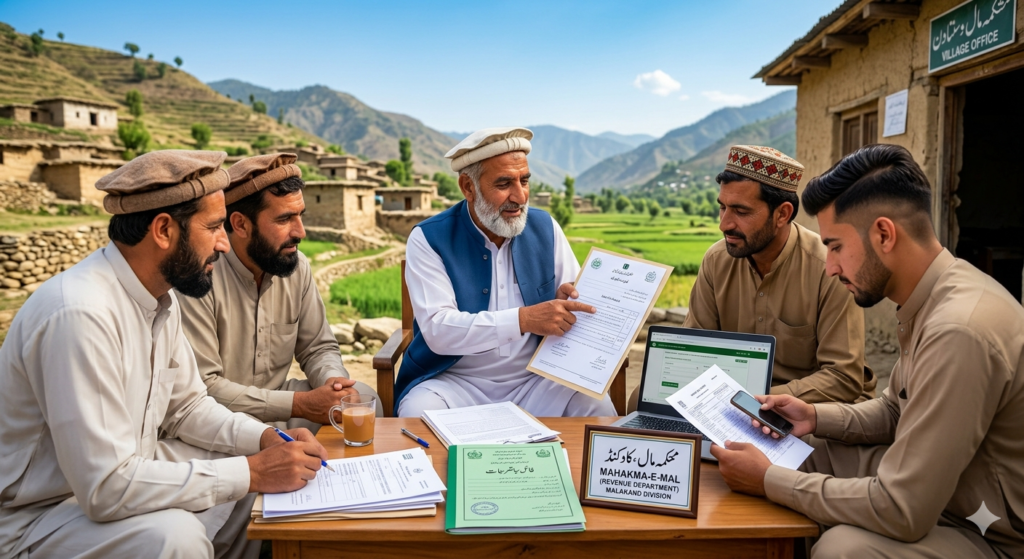
Part 2: Deconstructing the 5 Core Land Documents
To safely buy, sell, or hold property in Swat, Dir, or Buner, you must ensure that your transaction is correctly processed through the government Revenue Department (Patwar system) or the digital Service Delivery Centers (SDCs). These are the five foundational documents you need to understand:
1. The Fard (Fard-e-Malkiat / Record of Rights)
The Fard is an official extract of the Jamabandi (the government’s central register of rights, which is updated every four years). Think of it as the legal passport of your property.
- What it contains: It lists the exact names of the current owners, their specific shares (Hissa), the total area of the land holding, and whether the land is clear or currently mortgaged to a bank.
- My Legal Perspective: A Fard is issued for specific purposes. A Fard-e-Malkiat proves your ownership, while a Fard-e-Brai-Bay is issued specifically to execute a new sale. I always advise clients to demand a fresh, certified copy (Naoqal) bearing either the official stamp of the Halqa Patwari or the digital QR code of the computerized land record center.
2. The Mutation (Intiqal)
The single biggest mistake buyers make in Malakand is assuming that executing a sales deed or handing over cash marks the completion of the deal. Legally, you do not own the land until an Intiqal (Mutation) is formally entered and sanctioned in the government record.
- The Mechanism: An Intiqal is an administrative order that officially updates the state registry, transferring the ownership title from the seller to the buyer.
- My Legal Perspective: If you fail to get the Intiqal approved by the Revenue Officer (Tehsildar), the seller remains the legal owner on the state’s books. I think people underestimate this danger: if that seller passes away or turns dishonest, they can legally resell or mortgage your land to a third party.
3. The Registered Deed (Registry / Sale Deed)
While an Intiqal is an administrative entry, a Registry is a formal, binding legal contract executed under the Registration Act, 1908. It is drafted on high-security judicial stamp paper, signed by both parties, attested by witnesses, and officially registered by the Sub-Registrar of the Tehsil.
- Why it adds security: In areas of Malakand where land record computerization or formal government mapping is still an ongoing process, a registered Sale Deed provides the highest level of judicial security.
- My Legal Perspective: A Registry alone does not automatically update the Patwari’s register. It must be followed by a Mutation based on Registry (Intiqal Registry). I firmly believe that having both documents establishes an airtight legal title that is incredibly difficult to challenge in civil courts.
4. The Aks-Shajra (The Architectural Mapping)
Land ownership is practically meaningless if you cannot identify its exact physical boundaries on the ground. The Aks-Shajra is a certified trace or map of a specific plot of land drawn from the master village map (Shajra Kishtwar).
- What it prevents: It prevents boundary encroachments and overlapping claims by showing the geometric shape of your plot and its physical relationship to neighboring properties, public paths, or rivers.
- My Legal Perspective: When purchasing commercial or agricultural land along major highways or hubs like Mingora and Batkhela, I always tell my clients to cross-reference the Fard with the Aks-Shajra.You must ensure the physical dimensions match the measurement units (Kanal, Marla, Sarsai) listed in the revenue records to avoid buying a “floating” or non-existent plot.
5. The Khasra Girdawari (The Possession Register)
While documents like the Jamabandi prove your legal title (ownership), the Khasra Girdawari is the harvest inspection register, prepared on the spot by the Patwari twice a year. It records who is physically occupying and utilizing the land.
- Why it matters: It documents active cultivation or occupancy rights, stating whether the owner is using the land or if it is occupied by a tenant (Muzaria).
- My Legal Perspective: If you leave your land unattended and a third party manages to get their name entered into the Khasra Girdawari as a long-term cultivator without paying rent, evicting them can become a highly complex legal challenge under local tenancy laws. I think regular monitoring of this register is absolutely vital.
Part 3: The Internal KPK Divide—Malakand vs. Developed Districts
To understand why property fraud occurs more frequently in Malakand, we must look at how unevenly the Land Records Management Information System (LRMIS) has been implemented across Khyber Pakhtunkhwa.
| Feature / Issue | Malakand Division (Swat, Dir, Buner) | Peshawar & Mardan Districts | Abbottabad & Haripur (Hazara) |
|---|---|---|---|
| Status of Computerization | Broadly uneven. While Buner hit a 100% milestone, Upper Dir and Lower Dir remain heavily manual [Dir Upper, Dir Lower]. | Highly advanced. Mardan stands at 100% complete [Mardan], and Peshawar sits at 98% digitalized [Peshawar]. | Fully settled and mature. Abbottabad functions at 100% digitalized with established Service Delivery Centers (SDCs). |
| Primary Document Used | High reliance on the informal Bayan-Nama on unverified stamp papers. | Strictly dependent on digital Fard-e-Malkiat issued from automated portals. | Fully tracked digital Fard and court-registered sales deeds. |
| Boundary Disputes | Severe. Pockets lack historical surveys, creating border overlapping. | Minimal. Urban plots are bound by structural municipal layouts [Peshawar]. | Low. Clear colonial-era and modern topographic settlements exist. |
1. The “Settlement” Nightmare (Dir vs. Abbottabad)
In districts like Abbottabad, land records are deeply organized because formal cadastral mapping (scientific land surveying) has been maintained for over a century. In contrast, vast swathes of territory in Upper and Lower Dir remain Ghair-Bandobasti (unsettled) [Dir Upper, Dir Lower]. Because no official state maps or grid lines exist, property lines are defined by loose landmarks like “up to that tree” or “bordering that stream.”
I think this lack of hard data is the single biggest reason why fraudulent sellers can easily exploit innocent buyers in our region. Look no further than recent disputes brought before the Peshawar High Court Mingora Bench (Dar-ul-Qaza). In Muzamil Shah v. Syed Mohsin Shah (Writ Petition, 2025), the petitioners had to challenge revenue orders because entire swathes of Tehsil Dargai in the Malakand District lacked a formal Record of Rights [Dir Upper, Dir Lower]. Without an official settlement survey, state forums struggle to accurately process application parameters, creating immediate ground for messy litigation.
2. The Bayan-Nama vs. The Computerized Fard (Swat vs. Mardan)
If you buy property in Mardan, you go straight to a digital kiosk, undergo biometric verification, and receive an instantly trackable digital Fard [Mardan]. In valleys across Swat, many transactions are still recorded on basic white paper via a Bayan-Nama. This informal document is kept in private drawers rather than a centralized government database.
I think this is a major problem because it leaves no formal trail for the court to parse when multiple family members claim ownership of the same plot years later. Land buyers often fall into long-standing title traps. In historical cases like the 90-year old property saga Fateh Khan v. Deedar Shah (Civil Petition No. 394-P), the Supreme Court of Pakistan had to meticulously untangle ancient oral agreements from subsequent faulty mutation paperwork. The apex court explicitly warned that written documentation alone can be successfully challenged if it lacks clear, clean historical alignment with actual transactions.
3. Urban Influx and Commercial Pressure (Mingora vs. Peshawar)
Peshawar deals with modern corporate real estate challenges overseen by formal development authorities [Peshawar]. Meanwhile, commercial hubs like Mingora, Swat have experienced a massive boom in tourism hospitality and local markets.
In my opinion, this sudden surge in land value, combined with our outdated manual registry system, creates a perfect playground for land grabbers who exploit the slow manual system to block legitimate owners from accessing their property. This pressure triggers highly contested partition applications under Section 141 of the Land Revenue Act. In Amal Khan v. Aqal Muhammad (PHC Mingora Bench), the court exposed how bad-faith actors took inconsistent positions and refused to surrender excess land possession to legitimate co-sharers simply to obstruct fair partition and delay justice.
Part 4: Critical Analysis: The Women’s Property Rights Conflict in KPK
A major flashpoint in Malakand is the protection of female inheritance. While the KPK Enforcement of Women’s Property Rights Act was created to offer a swift alternative through the Provincial Ombudsperson, real-world practice has shifted.
The Peshawar High Court explicitly ruled that the Ombudsperson’s office cannot decide on highly complex, heavily contested civil property claims or titles requiring detailed witness cross-examination. I think this is a very crucial clarification for citizens in Malakand to understand. It means that if a family land dispute involves complex boundary claims or contested historical deeds, the only valid legal route is a formal title and partition suit filed in Civil Court under Sections 9 and 42 of the Code of Civil Procedure.
We see this frequently in active regional filings, such as Mst. Jehan Begum v. Muhammad Ali (Suit No. 18/1 of 2025) currently pending before the Senior Civil Judge, where massive ancestral properties remain joint because families fail to process clean, official partitions. I believe that attempting summary shortcuts through administrative complaints often leaves the property title unstable and easily reversed on appeal.
Part 5: Practical Legal Solutions Within the KPK Framework
We do not need to look outside our province for answers. The tools for reform already exist within the KPK legal code; they simply need strict execution in our northern districts. Here is what I think needs to happen immediately:
- Enforce Mandatory Registration of Local Deeds: The Commissioner of Malakand Division should issue an executive order under the Registration Act, 1908, declaring that any property transaction over a certain value executed via a Bayan-Nama is legally void unless registered at the local Assistant Commissioner’s office within 15 days.
- Redeploy Revenue Resources from Settled Districts: Now that Mardan [Mardan] and Abbottabadhave achieved 100% digital records, the KPK Board of Revenue should shift its technical staff and GIS drone equipment into Dir and Swat to finalize the regional settlement.
- Utilize Court-Annexed ADR for Boundary Adjustments: Rather than letting boundary disputes drag out in civil courts for decades, judges should aggressively apply the KPK Alternative Dispute Resolution Act, 2020. I believe this process is incredibly useful because it allows local referees to map out boundaries on-site and quickly lock the results into an official, binding court decree.
Part 6: The Malakand Property Verification Checklist (For Buyers & Investors)
Before handing over a single rupee for land in Swat, Dir, or Buner, you must complete this multi-step legal verification process. Skipping any of these steps leaves your investment exposed to litigation:
- Step 1: Check the Settlement Status: Verify if the area is Bandobasti (settled) or Ghair-Bandobasti(unsettled) [Dir Upper, Dir Lower]. If it is settled, demand a certified, fresh computer-generated Fard with a valid QR code from the nearest Service Delivery Center (SDC).
- Step 2: Cross-Reference the Joint-Khata Shares: If the property belongs to a shared family pool (Shamilat or Joint Khata), check the seller’s exact ownership fractional share (Hissa). A seller cannot legally hand over a specific physical corner of a joint plot without a formal, registered partition deed (Taqseem-Nama) signed by all co-sharers.
- Step 3: Conduct a Ground-Level Girdawari Audit: Do not rely solely on paperwork. Physically visit the land and match it against the Khasra Girdawari register held by the Halqa Patwari. If someone else is actively farming the land or living on it as a tenant (Muzaria), they may hold adverse possession rights that could block your use of the plot.
- Step 4: Insist on a Registered Sale Deed over a Bayan-Nama: Refuse to buy land using a traditional handwritten paper Bayan-Nama. Demand a formal deed drafted on high-security judicial stamp paper, and register it directly under the Registration Act, 1908 at the local Sub-Registrar’s office.
- Step 5: Verify the Mutation Entry: Once the sale is finalized, track the transaction until the Tehsildarformally signs off on the Intiqal (Mutation). Verify that your name successfully replaces the seller’s name in the state’s central registry.
Part 7: Step-by-Step Litigation Strategy for Overseas Pakistanis
The Malakand diaspora remains a prime target for local land grabbers and fraudulent family claims due to their physical absence. If you discover that your ancestral or purchased property has been illegally occupied, altered, or fraudulently sold, follow this aggressive, structured legal approach:
Step 1: Give a Limited Power of Attorney (PoA)
Do not issue a broad, unmonitored Mukhtar-e-Aam (General Power of Attorney) to a distant relative.
- The Action: Draft a highly specific, time-bound Mukhtar-e-Khas (Special Power of Attorney) solely for the purpose of defending or litigating the specific piece of land.
- My Advice: Execute this document directly at your nearest Pakistani Embassy or Consulate. Ensure it undergoes biometric integration linked to your NADRA profile before it is sent to Pakistan for attestation by the Ministry of Foreign Affairs (MoFA).
Step 2: File for an Immediate Injunction (Stay Order)
Time is your enemy. If land grabbers begin illegal construction on your property, evicting them later becomes much more complicated.
- The Action: Instruct your legal counsel to file a formal lawsuit for Declaration and Permanent Injunction under Section 42 of the Specific Relief Act, 1877, alongside an application under Order 39, Rules 1 & 2 of the Code of Civil Procedure (CPC).
- The Outcome: This forces the Civil Court to issue an immediate status-quo order (Stay Order), legally freezing all construction, sale, or alteration of the property while the main ownership case is decided.
Step 3: Utilize the KPK Enforcement of Women’s Property Rights Framework (If Applicable)
If the victim is an overseas sister or mother who has been cut out of a family inheritance mutation in Malakand, bypass standard civil court delays where possible.
- The Action: Utilize the targeted protections of the KPK Enforcement of Women’s Property Rights Act. File a direct complaint detailing the fraudulent omission to the Ombudsperson’s regional representative.
- The Outcome: This framework allows for swifter, state-backed administrative rectifications of clean inheritance cuts, bypassing decades of standard trial court backlogs.
Step 4: Criminal Counter-Measures via the Illegal Dispossession Act
If your title paperwork is completely clear and undisputed, but a land mafia or local group has physically seized the property by force, you do not need to wait for a slow civil trial.
- The Action: File a criminal complaint under the Illegal Dispossession Act, 2005 directly in the Court of the learned Sessions Judge.
- The Outcome: I think this is one of the most powerful tools available. This specific statutory tool criminalizes land grabbing. The court can order the local police to swiftly evict the illegal occupants and arrest the land grabbers, keeping the issue focused on unlawful physical eviction rather than a protracted civil title dispute.
Need Help Reviewing Your Specific Property Case?
Property laws in the post-merger Malakand Division require precise, aggressive, and timely intervention. Whether you are currently dealing with a family land dispute, require verification of complex revenue records, or need an airtight, biometric Special Power of Attorney drafted for an overseas relative, our firm brings decades of courtroom expertise to protect your rights.
Get in touch directly with Advocate Irfan Muazam to secure your legal title:
- 🌐 Official Website: advirfanmuazam.com
- 💬 WhatsApp Contact: +923462066302 (Click to Chat Directly)
- 📧 Email Counsel: info@advirfanmuazam.com / advirfanmuazam@gmail.com
- 🕒 Availability: Monday – Saturday | 09:00 – 17:00 (PKT)
- 📲 Social Portals: Connect via Facebook, LinkedIn, TikTok, or Instagram linked on our website gateway.