By Legal Desk | Updated November 2026
At the heart of constitutionalism lies a sober recognition of human nature. Unchecked authority inevitably gravitates toward expediency. At the same time, the collective public mind remains predisposed to convict individuals upon accusation alone. When executive functionaries bypass statutory procedures to satisfy populist impulses or administrative convenience, the rule of law erodes into arbitrary rule. Across the districts of Malakand Division, this tension between executive overreach and fundamental rights has crystallized into the defining constitutional dockets before the Peshawar High Court, Mingora Bench (Dar-ul-Qaza)
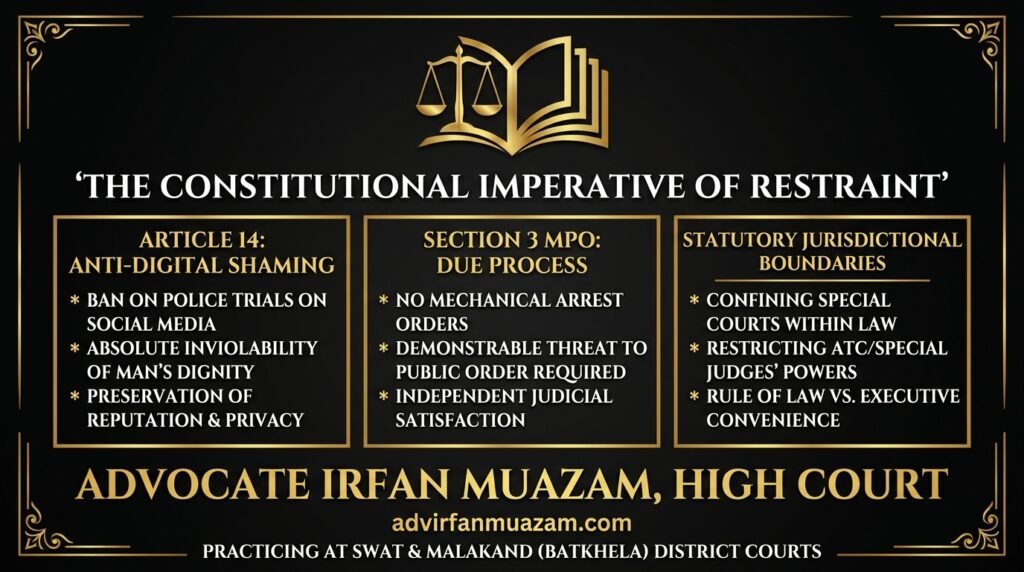
Through a series of decisive, groundbreaking interventions leading up to late 2026, Dar-ul-Qaza Swat has erected a formidable constitutional barrier against extrajudicial police practices, mechanical preventive detentions, and jurisdictional usurpation. These landmark rulings firmly reaffirm that state power remains strictly bound by the four corners of the Constitution of the Islamic Republic of Pakistan, 1973.
Executive Overreach vs. Constitutional Protections
The ongoing legal conflict within the Malakand Division highlights distinct structural contrasts between executive actions and established constitutional safeguards.
| Executive / Administrative Practice | Affected Constitutional Rights | Core Judicial Remedy & Resolution |
|---|---|---|
| Digital Public Shaming (Publishing names, parentage, and photos of suspects labeled as “mafia” on official Facebook pages without conviction) | Article 14(1) (Absolute Inviolability of Human Dignity) & Article 10-A (Presumption of Innocence). | Declared Ultra Vires: The court banned digital shaming by state organs. It ruled that police platforms cannot execute a “civil death” before judicial trial. |
| Mechanical 3-MPO Detention (Issuing generic, cyclostyled arrest orders using unverified files to bypass regular criminal procedures) | Article 9 (Security of Person) & Article 10 (Safeguards against arbitrary arrest). | Strict Judicial Scrutiny: Stripped executive authority of arbitrary shortcuts. Decreed that detention must address imminent safety threats, not evidentiary gaps. |
| Jurisdictional Usurpation (Special courts or magistrates executing actions, like ordering FIRs, beyond their specific written mandate) | Article 4 (Right to be dealt with strictly according to law) & Article 175 (Separation of Judiciary). | Complete Nullification: Quashed the resulting orders. Reaffirmed that special forums cannot assume powers not explicitly granted by their enabling statute. |
Executive Overreach vs. Constitutional Protections
I. Digital Pillorying and the Inviolability of Dignity under Article 14
In criminal jurisprudence, the presumption of innocence is not a procedural technicality. It stands as the foundational safeguard between an individual and the coercive apparatus of the State. Yet, human cognition is inherently vulnerable to cognitive bias. When an official state platform publishes an individual’s photograph alongside criminal labels, public perception instantaneously equates a state allegation with proven guilt.
This psychological vulnerability was weaponized across parts of Malakand Division—most notably in District Lower Dir. Local police authorities routinely published photographs, names, and parentage of unconvicted citizens on official Facebook pages. The posts publicly branded them as “qabza mafia,” “touts,” and “drug peddlers” in the absolute absence of any judicial conviction or statutory authorization.
In the landmark consolidated petitions titled Dilawar Khan v. The State (W.P. No. 1517-M/2025 & connected petitions, including W.P. No. 51-M/2026, adjudicated in 2026), petitioners invoked the constitutional jurisdiction of Dar-ul-Qaza Swat under Article 199. Confronted by the Bench, provincial law officers could point to no provision within the Police Rules, 1934, the Police Order, 2002, or any provincial enactment empowering law enforcement agencies to subject unconvicted citizens to public defamation.
Rejecting the State’s preliminary objection that the petitions involved disputed questions of fact, the High Court grounded its intervention in settled constitutional doctrine:
- Inviolability of Human Dignity (Article 14(1)): Unlike liberty or property, which may be curtailed in accordance with law, the dignity of man under Article 14(1) is unqualified and absolute. State-sponsored public shaming inflicts an irreversible civil death. A subsequent acquittal under Section 249-A or 265-K Cr.P.C. cannot restore a reputation dismantled by official state organs in the digital public square.
- Usurpation of Judicial Power (Articles 10-A & 175): The determination of criminal guilt is the exclusive constitutional prerogative of courts established under Article 175, following a fair trial guaranteed under Article 10-A. By adjudging citizens guilty via social media posts, executive functionaries acted coram non judice, substituting due process with trial by executive fiat.
- Principle of Legality: A citizen is free to do anything not prohibited by law, whereas a public functionary can do only that which the law affirmatively authorizes. Absent express statutory backing, the publication of accusatory dossiers by police authorities was declared ultra vires and void ab initio.
II. The Abuse of Preventive Detention: Section 3 MPO vs. Articles 9 and 10
The instinct of administrative authorities to favor shortcuts over evidentiary rigor is equally evident in the recurring invocation of Section 3 of the West Pakistan Maintenance of Public Order Ordinance, 1960 (3-MPO) across Malakand Division—from Swat and Dir to Tehsil Batkhela (District Malakand).
Establishing criminal culpability under the Pakistan Penal Code (PPC) requires admissible evidence collected under the Code of Criminal Procedure, 1898 (Cr.P.C.), tested through cross-examination under the Qanun-e-Shahadat Order, 1984. To evade this strict burden, district administrations have frequently resorted to issuing cyclostyled detention orders under Section 3 MPO based on vague, unverified police reports. These actions are often followed by nocturnal raids executed before the grounds of detention are communicated to the detainee or their family.
Applying strict scrutiny under Articles 9, 10, and 199, Dar-ul-Qaza Swat has consistently invalidated such executive excess on settled legal principles:
- Preventive vs. Punitive Jurisprudence: Preventive detention is an extraordinary constitutional exception intended solely to avert an imminent, demonstrable threat to public order. It is not a punitive instrument to incarcerate suspects against whom the prosecution lacks sufficient material to sustain a criminal trial or resist a post-arrest bail application under Section 497 Cr.P.C.
- Non-Delegable Duty of Subjective Satisfaction: Under Section 3 MPO, the District Magistrate/Deputy Commissioner acts as a persona designata and must apply an independent, judicial mind to objective material on record. Mechanical endorsement of police recommendations amounts to an abdication of statutory discretion and renders the detention order tainted with malice in law.
- Direct Amenability to Writ Jurisdiction: Where an impugned order strikes at the root of personal liberty under Article 9 and suffers from a jurisdictional defect or mala fide, the availability of an alternate departmental representation does not bar the High Court from exercising immediate corrective jurisdiction under Article 199.
III. Enforcing Jurisdictional Boundaries on Special Forums
Dar-ul-Qaza Swat’s commitment to the rule of law extends equally to policing the statutory boundaries of subordinate judicial forums. In recent appellate jurisprudence, such as Dr. Amjad v. The State (W.P. No. 165-M/2026), the Bench set aside an order and quashed a consequential FIR registered on the direction of a Special Judge, Anti-Terrorism Court (ATC), acting under Section 22-A(6) Cr.P.C.
Analyzing the statutory scheme of the Anti-Terrorism Act, 1997 alongside Sections 22 and 22-A Cr.P.C., the High Court held that a Special Judge ATC is a creature of a special statute. They do not hold the statutory status of an Ex-Officio Justice of the Peace unless expressly conferred by law. Reaffirming the foundational maxim that when the assumption of jurisdiction is void ab initio, the entire superstructure of subsequent proceedings falls to the ground, the Court quashed the FIR as a nullity in the eye of the law.
IV. Legal Commentary & Chambers Viewpoint
Legal Analysis: The Counsel’s Perspective
- The Erosion of Procedural Guardrails: Executive convenience must never substitute statutory procedure. When administrative functionaries issue detention orders on unverified recommendations, they convert a protective constitutional text into an instrument of harassment.
- The Irreparable Toll of Digital Defamation: A social media post published by an official platform destroys a target’s standing before a trial even begins. The absolute nature of Article 14(1) establishes that human dignity cannot be balanced against administrative expediency.
- The Remedy of Strict Judicial Oversight: Defending fundamental liberties demands immediate corrective intervention via Article 199 writ petitions. Subordinate special forums and executive tribunals must be restricted to the exact words of their enabling laws.
To explore localized litigation perspectives, practitioners across the division can review ongoing defense strategies on the Advocate Irfan Muazam Law Portal (advirfanmuazam.com). These digital resources trace evolving constitutional filings directly related to regional 3-MPO challenges and specialized criminal defense frameworks.
Conclusion
The jurisprudence emanating from Dar-ul-Qaza Swat reflects a profound institutional understanding of both constitutional law and human nature. Left unrestrained, administrative power inevitably seeks efficiency at the expense of individual rights. By striking down police trials on social media, curbing the mechanical invocation of Section 3 MPO, and confining special courts strictly within their statutory mandates, the Mingora Bench has reaffirmed an enduring constitutional truth: public order cannot be purchased at the cost of human dignity. The legitimacy of state action rests solely upon strict fidelity to due process of law.