
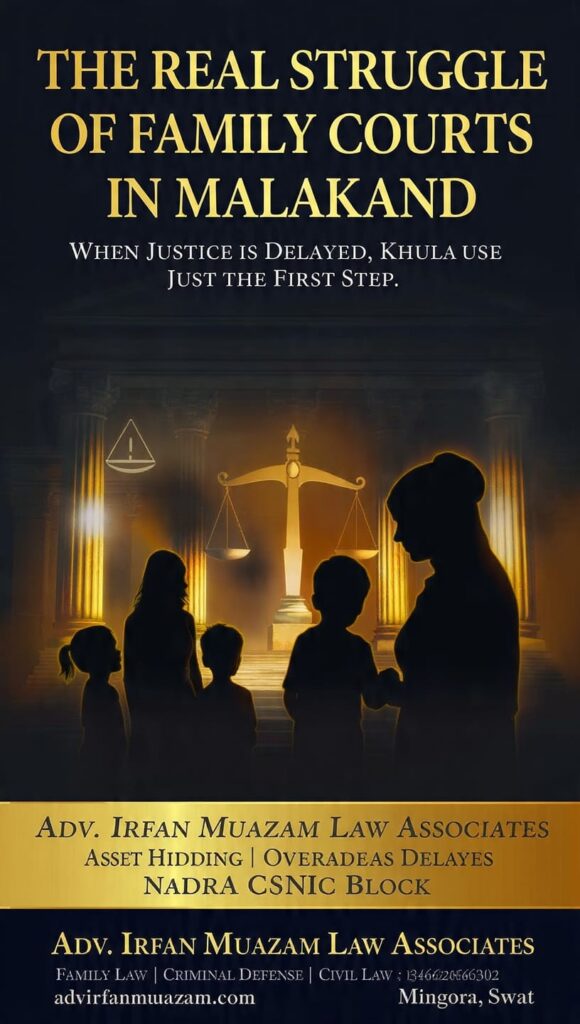
Getting a Khula (divorce) is often just the beginning of a long, painful battle for women in the Malakand Division. The real struggle starts when they try to get the dower (Haq Mehr) or the monthly child maintenance that the court ordered the ex-husband to pay. Even when a judge makes a fair ruling, many mothers are left totally broke because our system fails to force husbands to pay up.
As someone whose ultimate dream is to serve this region as the top lawyer in District Malakand, High Court Swat, Dir, and across the entire Malakand Division, I see these gaps every day. To fix a system, we have to understand exactly where it breaks.
Here is a complete, honest breakdown of the challenges women face in our family courts, and the steps required to bring real justice to our communities.
1. The Game of Hiding Money and Assets
When a judge asks a husband to pay child support, the first thing many men do is pretend they are completely poor. Because most people in Swat, Dir, and Bajaur work in the informal economy—like farming, driving local transport, or running small shops—there are no official salary slips or tax papers.
- Asset Concealment: Husbands exploit this lack of paperwork by temporarily transferring their land deeds, vehicles, or businesses into the names of their brothers or parents.
- The Burden on the Wife: The court places the burden of proof on the wife to show how much her husband earns. For a woman trapped at home, proving a husband’s hidden wealth is almost impossible without advanced legal help.
2. The Overseas Escape (The Remittance Loophole)
A massive chunk of Malakand’s economy depends on men working in the Gulf countries (Saudi Arabia, UAE, Dubai). This creates a massive legal loophole when a marriage collapses.
- Fleeing the Law: It is incredibly common for a husband facing a maintenance lawsuit to quickly board a flight and return to his overseas job.
- Systemic Paralysis: Once he is out of Pakistan, local police claim they cannot execute arrest warrants or seize his overseas income. The court’s maintenance orders become useless pieces of paper, leaving a mother stranded with no financial help.
3. The Endless “Trial After the Trial” (Execution Petitions)
Under the law, family cases are supposed to be decided quickly. But winning the main case is only half the battle.
- The Second Filing: Once a woman wins her case, she must file a separate legal request called an Execution Petition to actually force the husband to pay the money or hand over the gold.
- Delay Tactics: Defiant husbands use this stage to drag the case out for years. They change lawyers, file endless appeals, or simply stop showing up to court, turning the legal process into a long war of attrition that poor women cannot afford to fight.
4. Police Indifference and Social Pressure
To get a husband arrested or to seize his property, the court relies on local police. Unfortunately, the system is deeply infected by social biases.
- Low Priority: Local police stations often view family court orders as “private domestic issues” and put them at the bottom of their to-do lists.
- The Patriarchal Network: In close-knit rural pockets, police officers sometimes sympathize with the husband’s family, giving them a heads-up before a raid or intentionally delaying the execution of arrest warrants.
5. The Heavy Hand of Parallel Jirgas
Traditional tribal councils (Jirgas) operate right alongside our formal court system, and they heavily interfere with a woman’s financial rights.
- Forced Settlements: While a case is sitting in the execution phase, village elders often pressure the woman’s family to settle the matter out of court.
- Surrendering Rights: Under intense social pressure to maintain “village harmony,” vulnerable women are frequently coerced into forgiving or heavily cutting down their court-decreed dower and child support just to avoid a total social boycott.
6. Grassroots Governance and Paperwork Failures
The legal chaos often starts on the very day of the wedding because of poor administration at the local level.
- Blank Nikahnamas: Local Union Council clerks and Nikah Registrars regularly leave vital columns blank on the marriage contract, or write down arbitrary numbers for the Haq Mehr.
- Evidentiary Nightmares: When a marriage fails, the courts are left with poorly documented contracts. Verifying what the original dower amount actually was turns into an agonizingly slow trial, dragging out the suffering of the wife and children.
7. Traveling Obstacles and Missing Safe Spaces
The very geography of the Malakand Division penalizes poor female litigants.
- The Long Journey: For a woman living in Upper Chitral or the high mountains of Shangla, traveling down to district courts requires hours of expensive, hazardous travel.
- Intimidation at Court: Once they arrive, they are forced to wait in crowded, male-dominated corridors next to police escorts and criminals. The lack of secure, female-only spaces inside judicial complexes makes the experience highly intimidating and full of social stigma.
The Powerful Tool of Digital Enforcement: The Role of NADRA
To break through this wall of non-compliance, our superior courts are finally turning to technology. The National Database and Registration Authority (NADRA) is becoming a vital weapon for family lawyers.
- Tracking Relatives: Courts can now use NADRA’s Family Registration Certificates (FRC) to map out a husband’s family tree, stopping men from hiding wealth under fictitious names.
- Blocking Identity Cards: The most effective tool available is asking the court to order NADRA to block the husband’s Computerized National Identity Card (CNIC). A blocked identity card completely freezes a man’s life—cutting him off from bank accounts, mobile SIM cards, and government services until he clears his court dues.
- The Speed Gap: While this tool is incredibly powerful, the bureaucratic paperwork between rural courts and NADRA’s central offices is still too slow, allowing men a window of time to evade the system.
A Lawyer’s Perspective: Why Law Alone is Not Enough
Laws, asset tracking, and tech updates are absolutely vital. But we have to be honest with ourselves: the family court crisis in Malakand is a cultural emergency disguised as a legal failure.
The real problem is a deeply rooted social mindset that views a woman’s legal financial rights as an optional favor rather than a strict obligation. As long as our communities quietly condone a man who hides his wealth or runs away overseas to starve his own children out of anger toward his ex-wife, technology alone cannot save us.
True justice will stay out of reach until village elders stop weaponizing the idea of “family honor” to force women into predatory, unfair settlements. We must reach a point where our society shames the man who runs away from his children’s expenses, rather than judging the mother who walks into a courthouse to demand what is legally theirs. Bridging this moral gap between old traditions and constitutional justice is the highest duty of the next generation of legal minds.
How to Protect Your Rights
Navigating these high-conflict family cases requires aggressive asset tracing, deep local insight, and an unyielding commitment to the welfare of minors. Trusted local firms like Advocate Irfan Muazam Law Associates in Mingora, Swat, specialize in building strong defenses for vulnerable spouses and children against systemic delays and hidden income tricks. If you or someone you know is fighting a battle for child maintenance or dower recovery, you can reach out for dedicated legal representation directly through Advocate Irfan Muazam Law Associates.
One Response