
As a legal professional litigating cases before the District Courts and the Peshawar High Court Mingora Bench (Dar-ul-Qaza), I see firsthand how a single crossed-out line on a wedding day can alter the course of a person’s life. Far too often, clients walk into my chambers facing complex divorce, maintenance, or property disputes, completely unaware that the document holding the key to their legal relief was compromised before they even signed it. When family disputes arise, finding the best advocate in Swat becomes critical to fixing these early contractual errors.
In Pakistan, the Nikah Nama is not a mere religious formality or a sentimental scroll to be tucked away in a drawer. Under the Muslim Family Laws Ordinance, 1961, it is a powerful, high-stakes civil contract. If you treat it like an administrative afterthought, you are gambling with your future.
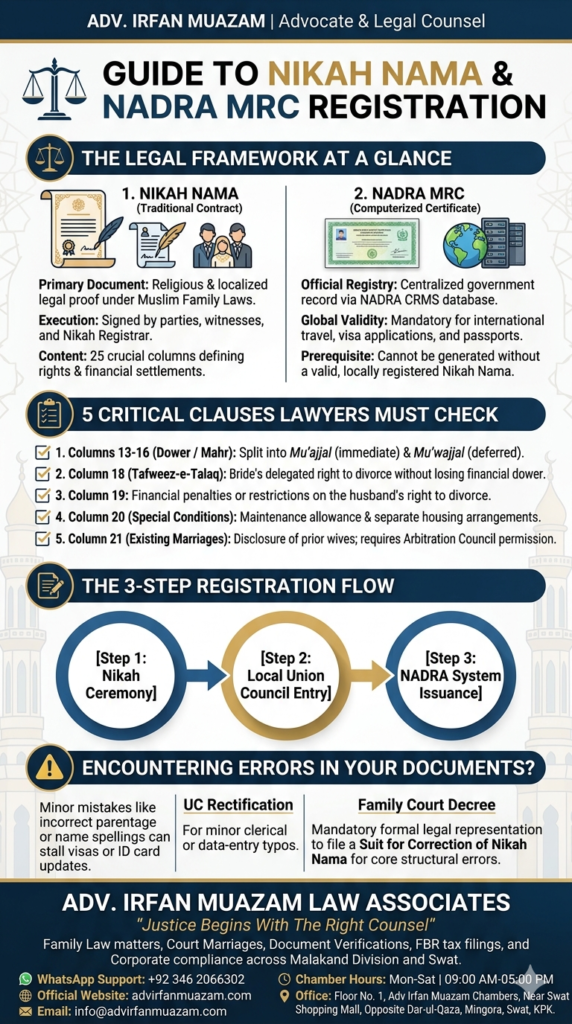
To safeguard your interests, this guide breaks down the critical clauses of the manual contract from a strict litigation perspective and details how to bulletproof your marriage by upgrading it to a computerized NADRA Marriage Registration Certificate (MRC).
Part 1: The Legal Audit — Crucial Clauses You Must Protect
The standard Nikah Nama consists of 25 clauses. In my practice, the biggest hurdle we face is overcoming the cultural pressure applied by elders or conservative clerics (Nikah Khawans) who arbitrarily cross out vital protections before the bride ever sees the page. This is an unauthorized alteration of a legal document. Both partners have an absolute, statutory right to negotiate, fill out, and protect every single section. If your rights have been compromised in this manner, consulting a good family lawyer in high court is the most effective way to seek legal remedies or draft rectifying deeds.
Columns 13–16: The Mahr (Dower) as an Absolute Debt
Mahr is a mandatory financial safeguard promised exclusively to the bride. From a legal standpoint, it behaves like an enforceable commercial debt.
- Prompt Mahr (Mu’ajjal): This is demandable by the wife immediately upon signing. If the husband refuses to pay, a family lawyer can file a recovery suit in Family Court during the subsistence of the marriage.
- Deferred Mahr (Mu’awajjal): This is payable only upon a specified triggering event—typically divorce or the death of the husband.
- The Attorney’s Advice: Never let anyone write “as per family custom” or leave these boxes blank. If property, gold, or land is pledged, demand exact identification numbers (such as plot, sector, or revenue Khasra numbers) in Column 16. Vague wording makes the clause legally void for ambiguity, rendering it useless in a court of law.
Column 17: Injecting “Pre-Nuptial” Protections
This blank section is a powerful tool for customization. Top legal practitioners frequently use this column to draft legally binding stipulations to protect a client’s lifestyle and financial stability. You can explicitly write in:
- A fixed, non-reducible monthly maintenance allowance (Nafqah) for the wife.
- The absolute right of the wife to pursue higher education or continue her professional career.
- A financial penalty or automated asset transfer clause if the husband violates bigamy laws.
Column 18: Talaq-e-Tafweez (The Ultimate Legal Shield)
This is the single most critical clause for a woman in Pakistan. It asks if the husband delegates his right of divorce (Talaq) to his wife.
- If marked “Yes”: The wife can dissolve the marriage through the local Union Council swiftly, keeping her dignity and—crucially—fully retaining her Mahr.
- If crossed out or marked “No”: The wife is stripped of this direct route. To exit the marriage, she is forced to file a lawsuit for Dissolution of Marriage via Khula. Under settled Supreme Court precedent, a court will grant a Khula, but it will almost always force the woman to forfeit her financial dower as compensation to the husband. Retaining the best advocate in Swat to ensure this clause is properly preserved prevents this severe financial penalty.
Columns 21–22: The Polygamy Check
These sections require the groom to declare if he has an existing wife. By law, a man cannot remarry without the written permission of his first wife and the local Arbitration Council. If a groom lies or strikes this out to hide an existing marriage, he faces immediate criminal prosecution for bigamy, fines, and immediate payment of his first wife’s entire Mahr.
The Jurisdictional Age Limit: In the Malakand Division and wider Khyber Pakhtunkhwa, minimum age laws are strictly monitored under the Child Marriage Restraint framework. A good family lawyer in high court will tell you that attempting to register a marriage where a party falls below the statutory provincial age limit will not only freeze your NADRA process but can trigger immediate criminal liability for the families involved.
Part 2: Upgrading to the NADRA Marriage Certificate
While the manual Nikah Nama satisfies religious requirements, state institutions do not recognize it for modern civil administrative needs. If you need to update a CNIC, change a passport, open a joint bank account, settle inheritance, or apply for an international spouse visa, you must hold a computerized NADRA Marriage Registration Certificate (MRC).
[Gather Documents] ➔ [Visit Union Council] ➔ [Data Verification] ➔ [Review Draft] ➔ [Collect Certificate]
1. The Pre-Filing Document Checklist
To ensure your application isn’t rejected by the clerk, gather the original documents and two clean photocopies of each:
- Original Manual Nikah Nama: Must bear the clear, legible ink stamp and signature of the licensed Nikah Registrar.
- Groom’s Valid CNIC / NICOP
- Bride’s Valid CNIC / NICOP
- Bride’s Father’s CNIC (Crucial for verifying lineage and data matching).
- Witness CNICs: Copies of the CNICs belonging to the two adult male witnesses who signed the manual contract.
The Registrar Serial Check: Before leaving for the Union Council, look at the top edge of your manual Nikah Nama. It must feature an official government-issued block number and serial stamp (Form II). Without this verified serial registry, the NADRA portal will flag the entry, and you will need the best advocate in Swat to file a verification suit in court just to clear your paperwork.
2. Jurisdiction: Finding the Right Local Office
NADRA does not issue marriage certificates directly to walk-ins. You must approach the Union Council (UC) Office or Municipal Committee Office within the exact geographic jurisdiction where your Nikah took place. Note: The location of this registration dictates which Family Court will hold territorial jurisdiction if any legal disputes arise in the future.
3. Application Processing & Data Entry
You will fill out a formal Marriage Registration Form provided by the UC Secretary. The details must be transcribed from your manual contract word for word. The secretary will cross-reference your Nikah Registrar’s credentials against government records before uploading the data into the secure NADRA local government portal.
4. The Critical Draft Review (The Attorney’s Warning)
Before the secretary hits submit, they will hand you a printed, unsubmitted rough draft. Do not skim this. Check every single letter and digit. An inverted number in a CNIC, a misspelled name, or an incorrect date of birth will instantly freeze future visa or immigration processes. Correcting a mistake after submission requires filing a lengthy, expensive rectification suit before a civil court.
5. Official Fees and Timelines
- Statutory Fee: Ranges between PKR 500 to PKR 2,000, depending on local government bylaws and urgent delivery options.
- Timeline: Standard verification takes 3 to 7 business days. Urgent tracking can often expedite the print within 24 to 48 hours.
The Litigation Safeguard: Pro-Tips for Real Protection
- Subpoena Insurance: Make sure your wedding witnesses are reliable individuals with valid CNICs. If the validity of the marriage or the bride’s free-willed consent is ever challenged in a criminal or civil court, these witnesses will be subpoenaed by the judge to testify under cross-examination.
- The Foreign Embassy Hurdle: For overseas Pakistanis or couples looking to move abroad, a NADRA certificate alone is not enough. You must take the final document to the Ministry of Foreign Affairs (MOFA) to get it stamped and authenticated. If your case involves complex international family laws or custody issues across borders, having a good family lawyer in high court handle your documentation and representation ensures compliance with both local and foreign regulations.
Conclusion: The Final Legal Verdict
My professional opinion is simple: Treat your Nikah Nama with the same legal scrutiny you would apply to a high-value business partnership.
Do not allow cultural awkwardness or family pressure to stop you from reading, understanding, and completing this document carefully. Ensure every condition is written out cleanly, and register your manual contract with your local Union Council immediately. By treating this contract with respect from day one and engaging the best advocate in Swat when disputes emerge, you establish an ironclad legal foundation that protects your rights, your assets, and your peace of mind for the rest of your life.